

 Scientific services
Laboratory analysis
Laboratory scientists service coordination
The Coordination of Scientific Services (CSC) of Invemar provides to public and private companies, environmental consulting services, through which basic and applied research is generated in marine and coastal sciences, providing quality information generated from field sampling.
CSC counts within Invemar facilities, with a specialized laboratory, divided into three areas of processes: Samples reception area, wet laboratory and optics laboratory. In these areas biological samples (i.e., plankton, nekton and benthos samples) are handled, analyzed and stored.
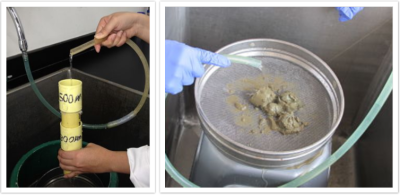
Samples reception area: In this area, samples are received and accounted for it has a washing area for the initial processing of the sample and hold-in storage for processed material. It is used for the washing of nekton and plankton samples to remove excess preservative (Formalin and Lugol, according to the case). Also, in this place zooplankton and Ichthyoplankton samples are subdivided. As for the benthos samples, the first stage of processing is done here which consists in the sorting of organisms in the two main groups (Macroinfauna and Meioinfauna) using two 12“ sieves with an aperture of 500 microns or 300 microns.
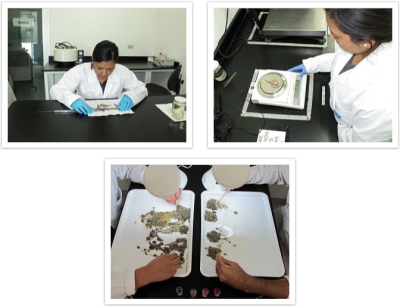
The wet laboratory is the space where the meristics and identification of nektonic organisms is done. It counts with analytical scales for the weighing of the organisms. In this laboratory also takes place the sorting or of benthonic organisms. The researchers and assistants use white trays and magnifying glass type lamps (in the case of macrofauna) and Bogorov plates looked over with stereoscopes (for meiofauna), in order to sort the organisms in large groups such as polychaete worms, crustaceans, molluscs, echinoderms and lesser-known groups such as nematodes, nemertinos and sipunculids among others.
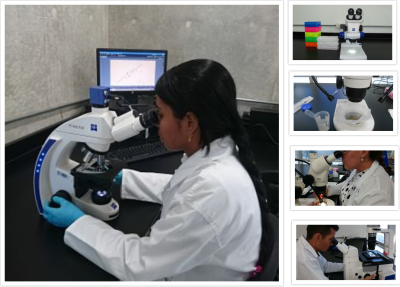
Optical Laboratory has 11 stereoscopes, five microscopes and two inverted microscopes. Here, the identification of organisms is done. This activity is performed by qualified and professional experts in taxonomy.
Additionally, the CSC has the support of Environmental Quality Laboratory (LabCam) for the processing and analysis of water and marine sediment samples; with the participation of laboratory assistants, technicians and professionals in chemistry.
Field work
The provision of consulting services has permitted basic research in marine and coastal sciences, through baseline studies, environmental monitoring and diagnostics.
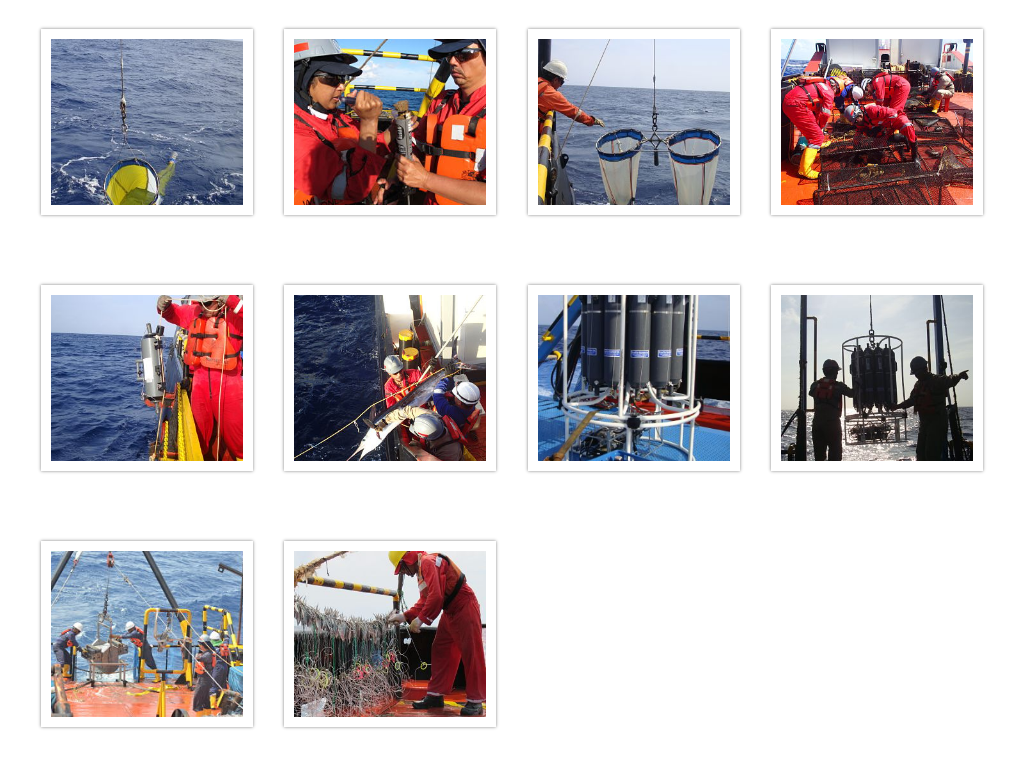
In the development of this activity, the CSC performs field campaigns in coastal and offshore environments where we conduct sampling of biological communities (Plankton, Nekton and Bentos) and water and marine sediments. For the sampling CSC uses the following equipment and materials:
Water quality component
- Niskin bottles online or coupled to oceanographic rosettes.
- Measuring probes for in situ analysis.
- CTDO for registration of physicochemical variables.
Analysis of sediment and benthic biological communities
- PVC Corers (in coastal areas with depths not exceeding three meters).
- Box van Veen dredges or box Core (depending on the type of sediment).
Planktonic communities
- Conical Nets for composition and Niskin bottles for abundance (phytoplankton).
- Bongo Nets with flow meters (zooplankton and Ichthyoplankton).


Close
Diganos su opinión
A través de éstas encuestas se busca medir el grado de satisfacción de nuestros usuarios frente a los servicios brindados por el INVEMAR.
Encuesta de percepción de la gestión institucional
Evaluación de los servicios prestados en el CDO
Encuesta de satisfaccion para los servicios del museo de Historia Natural Marina de Colombia